Before you pay for another AI course, try this
A seven-day plan to turn AI learning into a useful service sample: choose a customer, make something real, test the offer and publish your proof.

Another saved tutorial. Still nothing to show.
You’ve saved the tutorial. Joined the group. Collected the prompts. Somehow, the thing you wanted to make is still in your head.
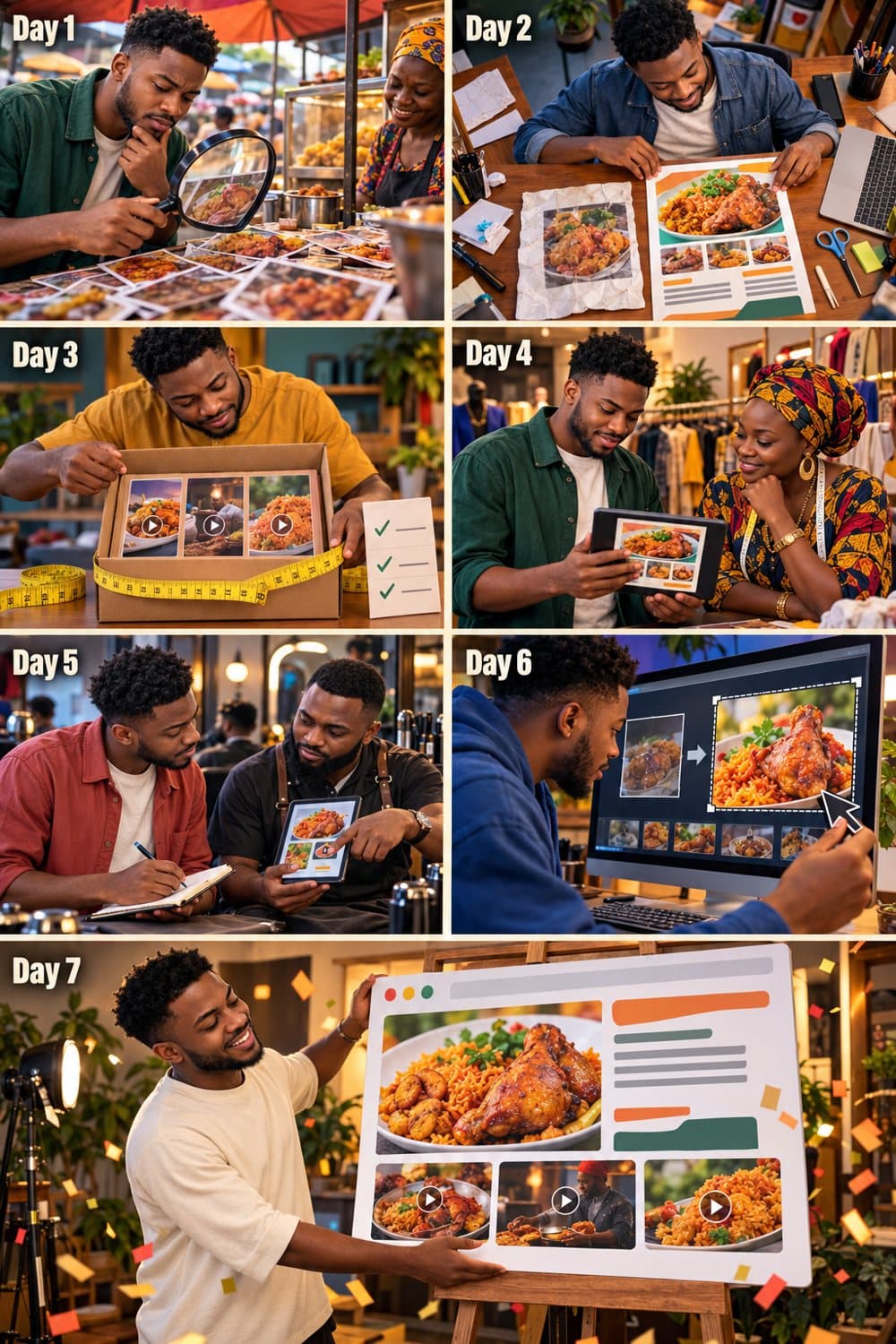
Give the learning a job this week: make one useful thing for one specific type of customer. This seven-day experiment aims for a finished sample and real feedback. A sale would be a bonus, not a promise.
Start with a problem people recognise
“I do AI” leaves a customer doing the thinking. “I turn your product footage into three short videos you can post this week” gives them something to assess.
Pick something you can already deliver, or reasonably learn to deliver: tidy a small product catalogue, edit three short clips, or turn a service list into a clear one-page brochure. Choose one. Trying all three is how next week becomes another week of research.
Days 1–2: make the sample
Pick one type of business—a food vendor, a clothing seller or a barber. Use your own material, get permission to use theirs, or make a clearly labelled fictional example. Show the original beside your finished version.
Use an AI tool to outline ideas or spot unclear wording. Do the checking yourself. A beautiful menu with the wrong prices is a problem wearing good clothes.
Day 3: put a boundary around the offer
Write down exactly what the customer gets: how many items, which file formats, what they must supply, when you can deliver, and how many revisions you include. Decide your price from the work involved and your costs. Don’t copy somebody’s dollar-income screenshot.
Days 4–5: ask for useful feedback
Show the sample to a few relevant people who are open to hearing from you. Ask: “Would this solve a problem for your business? What would stop you using it?”
If someone is interested, explain the scope and quote before beginning. Ask permission before making or publishing anything for their brand. Don’t mass-message strangers or promise results you can’t control.
Day 6: fix what they actually noticed
Maybe the text is too small. Maybe the video looks good but leaves out how to order. Maybe you made a brochure for a business that needed a price list. That feedback is more useful than another folder of prompts.
Day 7: publish the proof
Put the sample somewhere easy to open. Add three short lines: the problem, what you made, and what someone should send you to request it. Label concept work as concept work. No invented client, testimonial or sales result.
Your scorecard: one finished sample, one clear offer, and the objections you heard. If nobody wants it, change the offer before paying for more tools.
Borrow this prompt
Act as a practical editor. I want to offer [specific deliverable] to [type of business]. My current skills are [skills]. I have [time and equipment]. Help me define a small sample, the materials I need, a delivery checklist and five questions to test whether customers need it. Flag assumptions. Do not invent income claims or customer results.
Want structured training alongside the experiment? Google’s 2026 Hustle Academy announcement describes free AI-focused learning for entrepreneurs in Nigeria, Kenya and South Africa. Check the programme page for current sessions and eligibility.
Choose one deliverable and one kind of customer. Finish a sample, ask for feedback and improve the offer before buying more tools.
The source, so you can check.
This article combines reporting from the announcement below with Silk Studio’s own examples and commentary. Examples are illustrative, not customer case studies.